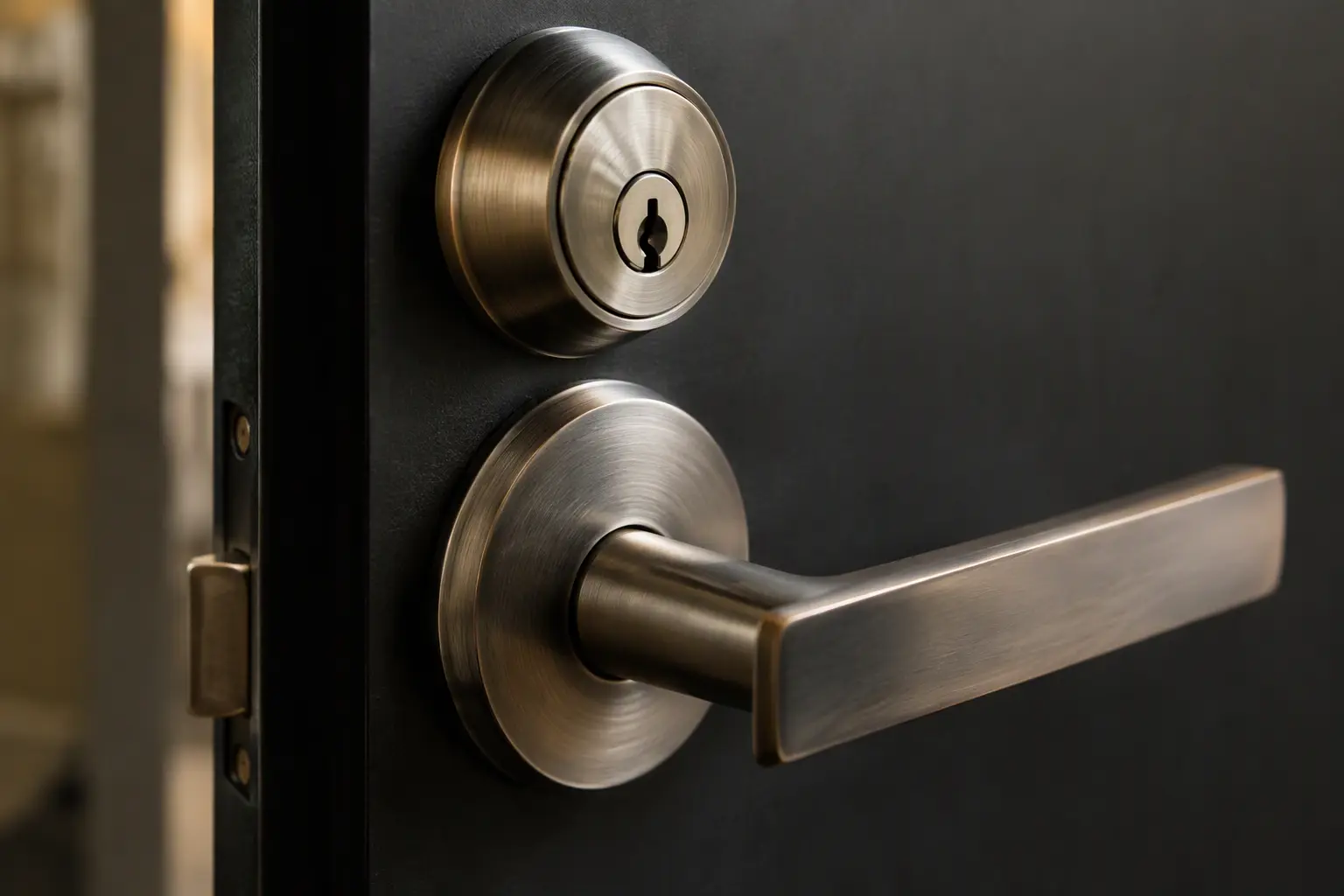
"Deadlock" and "deadlatch" sound almost the same, and plenty of people use the words interchangeably. They are different pieces of hardware that behave differently, and choosing the right one for each door makes a real difference to how secure and how convenient your home is. This guide explains both in plain language, then looks at which suits the doors on a typical Hills District home.
First, what is a plain latch?
To understand both, start with the simplest lock on many doors: a spring latch. This is the angled tongue that pops out of the edge of the door and clicks into the frame when the door closes. It holds the door shut, but because it is angled and sprung, it can sometimes be pushed back from the edge of the door with a thin object. A spring latch on its own keeps a door closed. It does not really lock it.
What a deadlatch does
A deadlatch is a spring latch with an extra part, usually a small plunger or trigger that sits beside the main latch. When the door is closed, the frame presses the plunger in, and that "deadlocks" the latch so it cannot be pushed back from outside.
The key point is that a deadlatch locks automatically when the door closes. You do not need a key to secure it. That is convenient, but it is also the reason many lockouts happen: step outside without your keys, let the door close, and you are locked out.
Many deadlatches also have a setting, often a button or a turn of the key on the inside, that stops the inside handle or knob from opening the door. That adds security when you are away.
Where deadlatches suit
- Front doors where you want the door to secure itself every time it closes
- Doors used by children or tenants who may forget to lock up
- Apartment and unit doors, where self-locking is common
What a deadlock does
A deadlock throws a solid, square-ended bolt into the frame when you turn the key or thumb-turn. Because the bolt is square rather than angled, and is not sprung, it cannot be pushed back from the edge of the door. It only retracts when you turn the key or thumb-turn again.
A deadlock does not lock itself. You have to lock it deliberately each time. In return, a well-fitted deadlock with a solid strike plate is one of the strongest everyday locks you can put on a timber door.
Single-cylinder and double-cylinder deadlocks
- Single-cylinder deadlocks have a key on the outside and a thumb-turn on the inside. You can lock and unlock from inside without a key.
- Double-cylinder deadlocks need a key on both sides. That stops someone breaking nearby glass and reaching in to unlock the door, but it also means you need the key to get out.
The second point matters for safety. In a fire, searching for a key to open the door is a real risk. If you choose double-cylinder locks, keep the key somewhere every person in the house can reach quickly, and talk the trade-off through with your locksmith.
Where deadlocks suit
- Front and back doors as the main overnight lock
- Side and laundry doors that are easy to forget
- Doors from an attached garage into the house
Deadlock vs deadlatch at a glance
| Deadlatch | Deadlock | |
|---|---|---|
| Locks automatically when the door closes | Yes | No |
| Bolt can be pushed back from outside | No, once deadlatched | No |
| Bolt type | Angled latch with trigger | Square, solid bolt |
| Typical cause of lockouts | Door closing behind you | Rarely |
| Best use | Everyday convenience | Strong overnight and away security |
Why many front doors have both
The most common arrangement on Australian front doors is a deadlatch or entry set for everyday use, plus a separate deadlock above it. During the day, the deadlatch keeps the door closed and secured each time someone comes and goes. At night, or when the house is empty, you turn the deadlock for extra strength.
If both locks are keyed alike, you only carry one key. That is something we can often arrange when fitting or rekeying your locks.
The door and frame matter as much as the lock
Neither a deadlock nor a deadlatch is stronger than the door and frame it is fitted to. The most common weak point we see in Castle Hill homes is a strike plate held into the frame with short screws into soft timber. Under force, the strike plate gives way long before the lock does.
Simple improvements, such as a heavier strike plate fixed with longer screws into the framing behind, cost little and add a lot. Our security locksmith service looks at the door, frame and lock together.
Alignment matters too. If a door has dropped, the bolt may only half-engage, which looks locked but is much weaker. If you have to lift or push the door to lock it, see our lock repair page.
Which lock for which door?
Front door
A deadlatch or entry set for daily use, plus a single-cylinder deadlock for nights and absences, is a good default. If there is glass beside the door, discuss a double-cylinder deadlock and its safety trade-off.
Back door
Often used less carefully than the front door. A deadlock is worth having, particularly if the back of the house cannot be seen from the street.
Laundry and side doors
These are frequently left with an old spring latch. Adding a deadlock is one of the most useful upgrades for many Hills District homes.
Internal garage door
The door from the garage into the house is a common weak point, especially if the garage door is left open or uses an old remote. A deadlock here is sensible.
Sliding doors
Sliding doors use their own locking hardware rather than a standard deadlock or deadlatch. Keyed sliding door locks and secondary locks are the usual options.
Can I add a deadlock to my existing door?
Usually, yes. Most solid timber and solid-core doors can take a deadlock. Hollow-core doors are not suitable for strong locks without reinforcement, and some aluminium and glass doors need specific hardware. Our door lock installation service covers fitting new deadlocks, and our lock replacement service covers swapping old hardware.
Common questions
Is a deadlatch as secure as a deadlock? A deadlatch is far better than a plain spring latch, but a well-fitted deadlock is generally stronger.
Why do I keep getting locked out? If your front door has a deadlatch, it locks itself whenever it closes. Keep a spare key with someone you trust nearby.
Should I get a key on the inside? It is a trade-off between security near glass and the ability to get out quickly. Many households choose a thumb-turn for safety.
Can my deadlock and deadlatch use the same key? Often, if the cylinders are compatible.
Get the right lock on each door
If you are not sure what is on your doors now or what should be, call Castle Hill Locksmith Service on 02 5023 3726 or request a quote with photos. We are at 4 Mandala Parade, Castle Hill NSW 2154, open 7 days, 7:00am to 10:00pm.
Need a locksmith in Castle Hill?
Call Castle Hill Locksmith Service on 02 5023 3726. Open 7 days, 7:00am – 10:00pm.