Rekeying is one of the most useful and most misunderstood jobs a locksmith does. It lets you keep your existing locks while making every old key useless, and in most cases it costs noticeably less than replacing the locks. This article explains what drives the cost of rekeying in Sydney's Hills District, when it is the right choice, and how to avoid paying for more than you need.
As with all our articles, we do not publish invented price figures. Every door is different. Instead, we explain how a fair rekeying quote is put together, so you can ask the right questions and compare quotes properly.
What rekeying actually involves
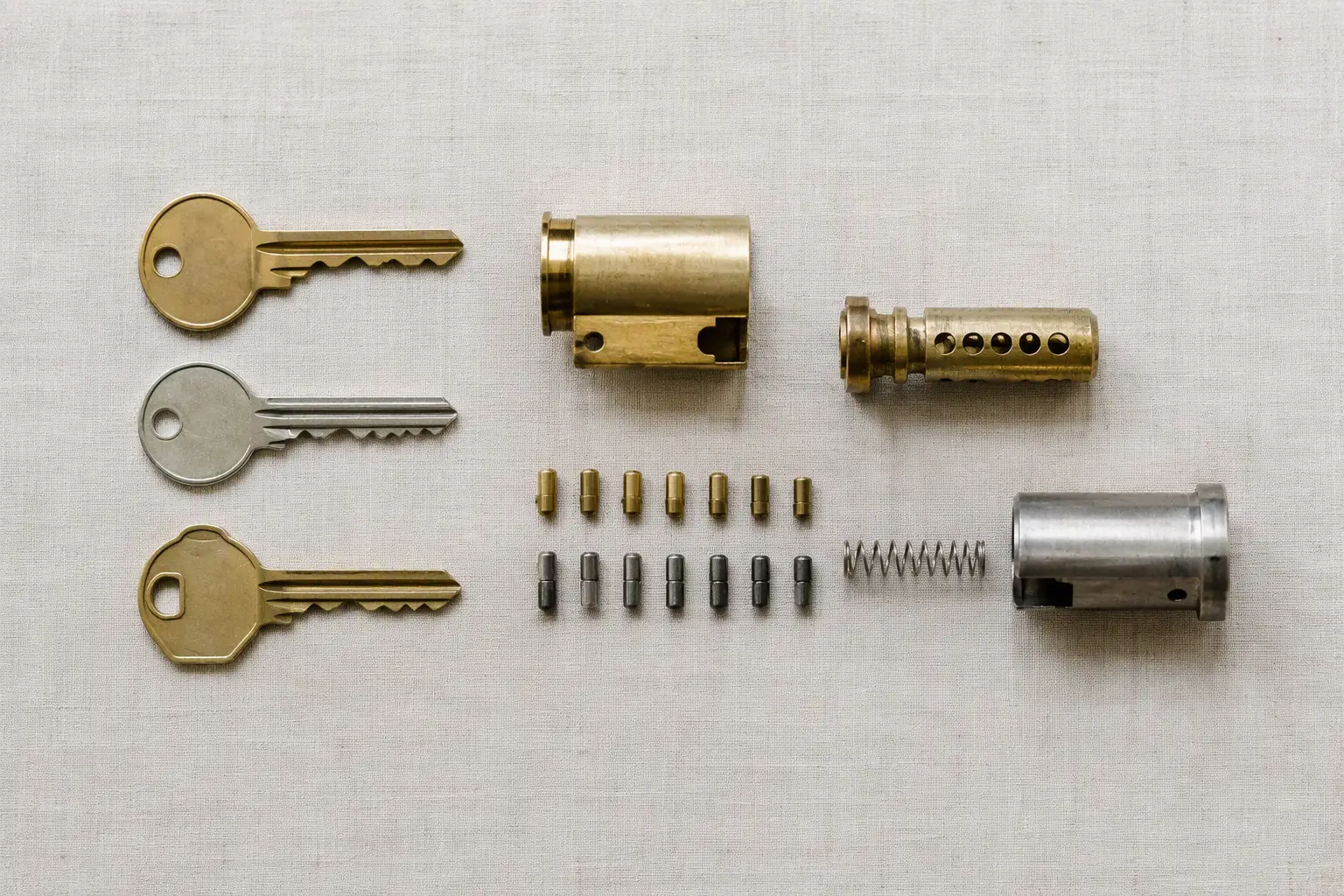
Most common locks use a pin-tumbler cylinder. Inside the cylinder is a row of small pins of different lengths. When the right key goes in, its cuts lift every pin to exactly the right height, which lets the cylinder turn and operate the lock.
Rekeying means taking the cylinder apart, removing the old pins and fitting a new set that matches a newly cut key. Once that is done, the old keys no longer line the pins up, so they will not turn the lock. Nothing changes on the outside of the door. The handle, the deadlock, the finish and the fit all stay exactly as they were.
That is why rekeying is usually cheaper than replacement: you are paying for skilled labour, a set of pins and new keys, not for a whole new lock.
The main factors in rekeying cost
How many cylinders you have
This is the biggest factor. A house with a single front deadlock is a small job. A house with a front door, a separate deadlock and handle set, a side door, a laundry door and an internal garage door may have six or more cylinders. Each one needs to be taken apart and re-pinned.
Doing them all in one visit is far more economical than doing them one at a time, because travel and set-up happen once.
The type of cylinder
Standard residential cylinders are straightforward. Some locks use cylinders that are harder to access, need to be removed from the door, or use proprietary designs. High-security restricted systems often cannot be rekeyed by anyone except an authorised supplier, and new keys may need to be ordered.
If you can tell us the brand stamped on your locks, we can usually tell you quickly how simple the job will be.
Whether the locks can share one key
Many people want one key for every door. Whether that is possible depends on whether the locks use compatible cylinders. If they do, putting them all onto one key adds little or nothing to the job. If one lock uses an incompatible cylinder, the options are to keep a separate key for that door or to replace that one cylinder or lock with a compatible one.
How many keys you need
Each new key has to be cut. Most households need a few; businesses often need more. Tell us the number up front so it is included in the quote.
The condition of the locks
Rekeying a lock that is worn out does not fix the wear. If a cylinder is badly worn, or the lock body is failing, we will tell you that rekeying is not good value for that lock and explain what replacing it would involve.
When rekeying saves you money
Rekeying is usually the better-value choice when:
- the locks work smoothly and are in good condition
- you are happy with the type and look of the existing hardware
- the only problem is that you do not know who holds keys
That covers the most common situations we see across the Hills District: buying a house, moving into a rental, a tenant leaving, a lost key, or a staff member leaving a business. Our lock rekeying page explains the process in more detail.
When replacement is the better spend
Replacement makes more sense when:
- a lock is stiff, worn or damaged
- you want a different type of lock, for example a deadlock where there is only a latch
- parts for an old lock are no longer available
- the lock has been damaged in a break-in
In some cases a mix is best. You might rekey four good locks and replace one tired one, keying the new lock to match the others. See our guide to whether to rekey or replace and our lock replacement page.
Rekeying for rental properties
For landlords and agents, rekeying between tenancies is one of the simplest ways to look after a property. It gives the incoming tenant keys that only they hold, without the cost of new hardware every time someone moves out.
In NSW, landlords and tenants generally need to agree before locks are changed, and each must be given a copy of any new key. Read our article on landlord and tenant lock change rules in NSW before booking, and check the current rules with NSW Fair Trading. Our residential locksmith page covers rental work too.
Rekeying for businesses
For shops, offices and clinics, rekeying after a staff member leaves answers the question of whether a working key walked out of the door. The cost depends on how many doors that person's key could open.
Some businesses find it worth setting up a simple key arrangement where the manager's key opens every door and staff keys open only some. That way, a lost staff key means rekeying fewer doors next time. Our commercial locksmith page explains this.
How to keep rekeying costs down
- Do every external door at once. One visit costs less than several.
- Know your lock brands. A photo of each lock face lets us confirm compatibility before we arrive.
- Decide on one key or several before we start. Changing the plan mid-job takes extra time.
- Be clear about how many keys you need. Cutting them on the day is easier than coming back.
- Do not forget the garage, laundry and side doors. Leaving one door on an old key defeats the purpose.
What you should expect from a rekeying quote
A clear rekeying quote should tell you:
- how many cylinders are included
- whether they will all be on one key
- how many keys are included
- whether any lock needs replacing rather than rekeying, and why
If a quote does not cover these points, ask. A good locksmith will be happy to explain.
Common questions about rekeying cost
Is rekeying always cheaper than replacing? Usually, but not always. If a lock is worn out or incompatible, replacement can be the better value.
Will my old keys still work? No. Once a cylinder is rekeyed, keys cut for the old pins will not turn it.
Can a deadlock and a handle set be put on one key? Often, if their cylinders are compatible. We check when we look at them.
How long does it take? A single cylinder is a short job. A whole house takes longer. We give you a time estimate with the quote.
Ask for a rekeying quote
If you have moved in, lost a key or had a change of tenant or staff, rekeying is usually the simplest fix. Call Castle Hill Locksmith Service on 02 5023 3726 or request a quote with photos of your locks. We are at 4 Mandala Parade, Castle Hill NSW 2154, open 7 days, 7:00am to 10:00pm.
Need a locksmith in Castle Hill?
Call Castle Hill Locksmith Service on 02 5023 3726. Open 7 days, 7:00am – 10:00pm.