For a business, a lock is part of daily operations. Staff arrive and leave, deliveries come through the back, cleaners work after hours, and the front door may open hundreds of times a day. When a lock fails, it rarely fails at a convenient time. When a key goes missing, the question of who can get in becomes a real business risk.
This guide is for owners and managers of shops, offices, clinics, cafes and trade premises across Castle Hill, Norwest, Bella Vista and Baulkham Hills. It covers the lock and key decisions that matter most for a business, written from the point of view of a local locksmith who works on these doors every week.
Start with key control
Most commercial lock problems are really key problems. A business that cannot say who holds which key cannot be sure who can get in. Good key control is simple, cheap and the foundation of everything else.
Keep a key register
A key register is just a list. For each key, record:
- which doors it opens
- who holds it
- when they received it
- when it was returned
A spreadsheet is fine. The point is that when someone leaves, you can see straight away which doors their key opened and whether it came back.
Give people only the keys they need
Not every staff member needs a key to every door. A cleaner may need the front door and the store room. A casual may not need a key at all. A manager may need everything. The fewer keys that open the most sensitive doors, the less you have to rekey when a key goes missing.
Use restricted keys where it matters
Standard keys can be copied at many key-cutting counters. Restricted key systems use keys that can only be copied by an authorised supplier with the business's permission. For businesses with high staff turnover or sensitive areas, that control can be worth the extra cost. Ask us whether your existing locks can be converted.
When a staff member leaves
This is the most common commercial call we get. Someone has left, on good terms or bad, and the key either did not come back or might have been copied.
The answer is usually rekeying the doors that person's key opened. Rekeying keeps your existing hardware and makes the old key useless. Because the hardware stays, it is usually far cheaper than new locks.
If staff changes are frequent, a master key arrangement can reduce costs over time. The manager's key opens everything; staff keys open only the doors each role needs. When a staff key goes missing, only those doors need attention.
Doors that work hard
Commercial doors take far more use than house doors. The first signs of wear are usually small:
- a key that needs a wiggle at opening time
- a latch that does not catch unless the door is pushed
- a door closer that slams or does not close fully
- a handle that has started to droop
Each of these is cheap to fix early and expensive when it fails on a busy Saturday. Our lock repair service covers commercial latches, cylinders and strike plates.
Door closers
A closer that has lost its adjustment can stop a door latching, which means a door you thought was secure is actually open. Closers can usually be adjusted; worn ones can be replaced.
Glass shopfront doors
Shopfronts in Castle Towers' surrounding streets, Castle Mall and local strips often use frameless glass doors with patch locks at the bottom or top. These use their own hardware, quite different from a timber house door. Worn patch locks are common on busy doors and can usually be serviced or replaced without replacing the glass.
Aluminium framed doors
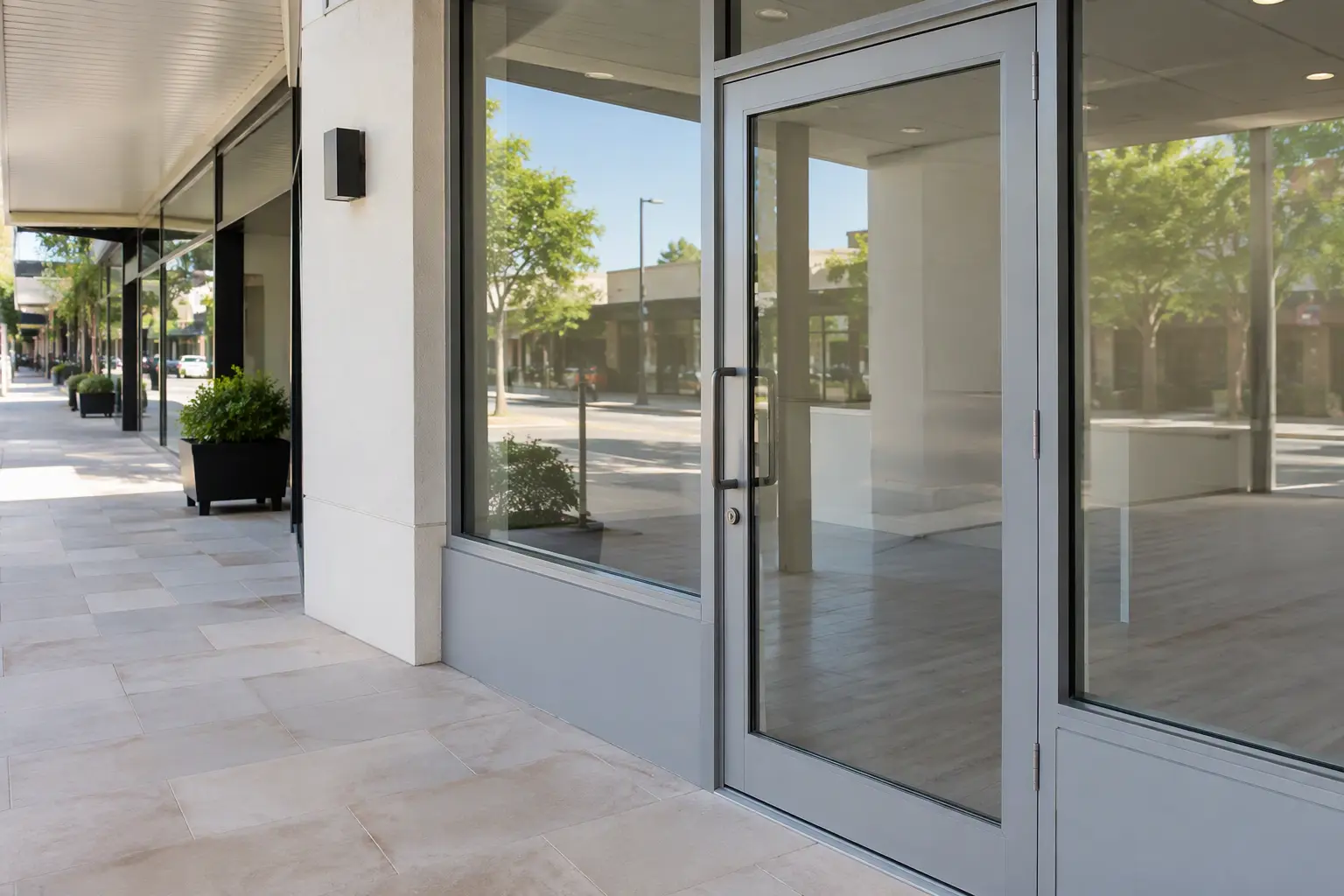
Many offices and trade premises use aluminium framed doors with narrow-stile locks. The lock body sits in a narrow frame, so replacement needs the right size of hardware. A photo of the lock face and the brand helps us bring the right part.
Back-of-house and sensitive areas
Front doors get attention because customers see them. Back doors, store rooms, cash rooms, records rooms and comms cupboards often get much less, even though they protect more.
Rear and delivery doors
Back doors to retail premises often open onto lanes and car parks out of public view. They should have a solid lock, a good strike plate and a closer that shuts them reliably. Many businesses also need these doors to open easily from inside for emergency exit, which affects the type of lock that can be fitted. Our security locksmith service looks at these trade-offs.
Records and medication rooms
Clinics and offices in the Norwest area often have rooms that must be restricted to a few people. A separate key, or a key on a restricted system, keeps those rooms under control.
Cash and stock rooms
For shops, the stock room and any area with cash deserve a deadlock and a short list of keyholders.
Fire exits and the law
Exit doors in commercial buildings have specific requirements so people can get out quickly in an emergency. You generally cannot simply add a key-operated deadlock to a required exit door if it would stop people leaving. If you are unsure whether a door is a required exit, check with your building manager or a fire safety professional before changing its lock. We will always raise this before fitting hardware to a door that might be an exit.
Working around trading hours
Lock work can usually be planned so it does not interrupt trade. We are open 7 days, 7:00am to 10:00pm, which lets us do most commercial jobs before opening or after close. For multi-door rekeying, we can work through doors in an order that keeps the business running.
Leased premises
If you lease your premises, check your lease before changing locks. Many commercial leases require landlord consent for changes to the building, and the landlord may need a key. Shared entries, car parks and lifts in office buildings are usually controlled by building management. We work on your tenancy doors and coordinate with management where shared hardware is involved.
After a break-in at a business
If your premises are broken into:
- Do not enter until you are sure no one is inside. Call 000 if needed.
- Report it to police and get an event number.
- Photograph the damage before repairs.
- Call your insurer.
- Have the premises made secure.
Our emergency locksmith service handles urgent securing during our hours. Our article on what to do after a break-in covers the steps in more detail.
A simple commercial lock checklist
- Keep a key register and update it every time a key changes hands.
- Give each person only the keys they need.
- Rekey when a key is not returned.
- Fix stiff locks and slow closers early.
- Secure back and delivery doors as well as the front.
- Restrict sensitive rooms to a short list of keyholders.
- Check exit-door requirements before changing a lock.
- Check your lease before changing anything shared.
Common questions
Can several doors use one key? Often, yes, depending on the cylinders. We can also set up keys that open only some doors.
Can you work outside our trading hours? Yes, within our hours of 7:00am to 10:00pm, 7 days.
Do you install electronic access control? No. We work on mechanical locks and keys.
Who can authorise key cutting for our business? Someone authorised by the business. We confirm this before cutting.
Talk to us about your premises
Castle Hill Locksmith Service works with shops, offices and clinics across the Hills District. Call 02 5023 3726, open 7 days, 7:00am to 10:00pm, or request a quote. We are at 4 Mandala Parade, Castle Hill NSW 2154. Read more on our commercial locksmith page.
Need a locksmith in Castle Hill?
Call Castle Hill Locksmith Service on 02 5023 3726. Open 7 days, 7:00am – 10:00pm.